| |
| Wednesday, 18 November 2026 |
| DRESSED TO THRILL : The Art of the Japanese Kimono |
| Marie Conte-Helm |
 |
To book a seat click here The kimono, literally meaning ‘wear’ (ki) and ‘thing’ (mono), is a traditional garment worn by both men and women in Japan. But it is so much more than that. Rich in symbolism and encapsulating the best in textile design and techniques through the ages, the kimono has a fascinating history that reflects wider aspects of Japanese life and culture. This lecture will trace the story of the kimono, its past and its present, and the place that it occupies in the world of contemporary fashion.
Lecturer: Professor Marie Conte-Helm has lectured extensively on the history, arts, and culture of Asia, the Pacific, and the wider world and is an Accredited Lecturer of The Arts Society and a Fellow of the Royal Society of Arts. She holds higher degrees in the History of Art and in Asian Art from the City University of New York and the East West Center of the University of Hawaii and conducted her postgraduate research on Chinese Landscape Painting at the National Palace Museum in Taipei.
Professor Conte-Helm has served as Executive Director of the UK-Japan 21st Century Group and Director General of the Daiwa Anglo-Japanese Foundation, the largest UK charity supporting links between the two countries. She has held academic posts as Reader in Japanese Studies and Director, East Asian Developments at Northumbria University, and as Head of the Japanese Studies Division at the University of Sunderland. Her book publications include The Japanese and Europe: Economic and Cultural Encounters and Japan and the North East of England: From 1862 to the Present Day.
She was awarded an OBE in the 2011 Queen’s Birthday Honours for services to UK-Japan educational and cultural relations. In 2019 she was awarded the Order of the Rising Sun, Gold Rays with Rosette by the Government of Japan ‘in recognition of her long-time dedication and significant contributions to the promotion of mutual understanding and cultural exchange between Japan and the United Kingdom’. |
|
| Wednesday, 09 December 2026 |
| DANCE OF THE SUGAR PLUM FAIRY: the Christmas Story of Tchaikovsky & The Nutcracker |
| Rosamund Bartlett |
 |
To book a seat click here Before The Nutcracker became everybody's favourite Christmas ballet, it was staged in Tsarist Russia. With reference to the glorious history of the Imperial Ballet company in St. Petersburg, this lecture discusses how Tchaikovsky came to write his magical scoreand Petipa created its choreography, and also tells the story of the dancers who created the leading roles. It also explores Tchaikovsky's role in transforming classical ballet into the vibrant art form it is today.
Lecturer: Rosamund Bartlett is a writer, translator and lecturer. A cultural historian with a background in Russian literature, music and art, her books include Wagner and Russia and Tolstoy: A Russian Life. She has also written a biography of Chekhov, and published translations of his short stories and letters. Her new translation of Anna Karenina was published in 2014. Her current interests focus on Russian and European Modernism, opera, and the intersection between politics, history and the arts. She has lectured on these and other topics, including Tchaikovsky, Chekhov and Levitan, Matisse in Moscow, Kandinsky and The Blue Rider, and Modernist women artists, both in the UK and abroad. |
|
| Wednesday, 20 January 2027 |
| DISCOVERING MacDONALD GILL: Architect, Artist & Mapmaker |
| Caroline Walker |
 |
To book a seat click here MacDonald 'Max' Gill, younger brother of the sculptor and typographer Eric Gill, was an architect, graphic designer and letterer, best known for his pictorial maps, especially those for the London Underground. This illustrated talk by Max Gill’s great-niece presents a colourful overview of this versatile artist's personal life and artistic achievements. NB. Max's work can be found in many localities around Britain. Caroline will include local connections wherever possible.
Lecturer: Caroline Walker is a leading researcher on her great-uncle, the architect and cartographer MacDonald 'Max' Gill, she is the author of MacDonald Gill: Charting a Life and frequently gives talks on his pioneering maps and the broader Gill family legacy. |
|
| Wednesday, 17 February 2027 |
| FRICK: The Man and his Museum |
| Mark Meredith |
 |
To book a seat click here FRICK: The Man and his Museum, just who was Henry Clay Frick? And how did this man who ditched the classroom for the soot, filth, bloodshed and danger of industry become the most prominent art collector of his generation in America, and the benefactor of its finest collection of European paintings? We'll take an intimate look into his private life and personal demons, and the inner-fire that drove him to collect, curate, and give away a world-class museum.
Lecturer: Mark Meredith is a regular Speaker at the New York Adventure Club; and, has lectured at various societies across Europe and the States including the New-York Historical Society.His area of special interest is American social history and architecture. He says, "I don't just “give a lecture”, I like to tell a story. My lectures are richly illustrated, laced throughout with humour and, by the time we reach the end, my aim is to leave the audience buzzing with thoughts and opinion. |
|
| Wednesday, 17 March 2027 |
| ENGLISH ARCADIA: The History of the English Garden |
| Barbara Peacock |
 |
To book a seat click here In this lecture we shall trace the development of English gardens from Tudor times through to the twentieth century. Our early formal gardens owe much to the influence of Italy and France, and although most were destroyed in the later vogue for the ‘naturalistic’ landscape park, we can form an excellent idea of their appearance through paintings and engravings. In the 17th century, the more intimate gardens of the Tudor and Stuart period give way to grandiose formal layouts inspired by Versailles and many fragments of great formal schemes survive.
Lecturer: Barbara Peacock, architectural historian and experienced lecturer RSA also organises and leads art and architectural tours in UK and abroad. She is very much involved in the preservation of the architectural heritage of the Czech land and has been awarded the Lifetime Achievement Award by the Czech government and the Points of Light Award from the UK Prime Minister, Theresa May. |
|
| Wednesday, 21 April 2027 |
| WILLIAM J NEATBY: the Master of Harrod’s Meat Hall
A master of fin-de- siècle art and design in Britain. |
| Scott Anderson |
 |
To book a seat click here WILLIAM J NEATBY: the Master of Harrod’s Meat Hall
A master of fin-de- siècle art and design in Britain. This lecture charts his career from his beginnings as a ceramic artist in Leeds to his time as Head of Doulton’s Architectural Ceramics Department, and beyond. Topics for study include his graphic work, designs for architectural ceramics, and his work as a book illustrator and wallpaper designer. One of the few designers to work in the Art Nouveau style in England, Neatby created artworks that are still a visual feast for those interested in art and design in the years around 1900.
Lecturer: Scott Anderson trained as an archaeologist at Leicester University and was a professional archaeologist for ten yearts before his interests shifted to the world of art, antiques and auctioneering. in 1994 he joined the team at Southampton Solent Unoiversity lecturing on the only BA (Hons) degree course of its kind to look at the commercial art world. Now, as a Senior Lecturer, he teaches course on the history and theory of interior design and visual culture. He has lectured to many adult audiences for a variety of University Extra-mural departments and the WEA. For the last few years he has also worked as a consultant valuer for the BBC television programme Flog it. |
|
| Wednesday, 19 May 2027 |
| WOMEN BEHIND THE LENS: Outstanding Female Photographers and their Contribution to the Art of Photography |
| Brian Stater |
 |
To book a seat click here The work of women photographers has often been unfairly neglected. This lecture seeks to correct that by examining the contribution of three outstanding British practitioners: Julia Margaret Cameron, a Victorian pioneer; Jane Bown, a brilliant portraitist; and Fay Godwin, who excelled in landscape photography. We also explore the work of two highly influential Americans: Dorothea Lange, who produced brilliant documentary images and Annie Leibovitz, who continues to both surprise and delight her audience.
Lecturer: Brian Stater lectured at University College London for 25 years, retiring in 2021 as a Senior Teaching Fellow. His principal academic interest lay in the appreciation of architecture and he has a lifelong enthusiasm for photography. He therefore offers lectures to The Arts Society on each of these subjects. He has written on architecture for a wide range of publications and an exhibition of his own photographs was held at UCL. Brian is a former member of the Association of Historical and Fine Art Photography. He works with a range of cameras, including a pre-War Leica as used by his great hero, Henri Cartier-Bresson, and many others. Brian is an engaging and amusing speaker who seeks to entertain as well as inform his audience. |
|
| Wednesday, 16 June 2027 |
| THE ART AND CRAFT OF JOHN PIPER |
| Jo Walton |
 |
To book a seat click here An abstract painter in the 1930s, John Piper was also a writer, critic and typographer and his love of architecture – especially medieval churches and stained glass – made him a highly sensitive observer of his surroundings. During the Second World War he became one of the best-known Official War Artists, creating powerful images of the destruction of Coventry Cathedral, the Houses of Parliament and of the city of Bath, as well as recording a wide range of buildings, from derelict Welsh cottages to the grandeur of Windsor Castle.
Lecturer: Jo Walton is a freelance lecturer, specialising in Renaissance and Baroque art and architecture and in British art of the 19th and 20th centuries. She studied art history at Leicester University, then went on to do a post-graduate diploma in Oxford on the art and architecture of 15th century Italy. A job in a bookshop turned into a happy and successful twenty-year career in the book trade, eventually running a specialist art bookshop in London, and working with the auctioneers Christies. As well as teaching adult education classes in art history she was for 12 years a volunteer guide for Tate Modern and Tate Britain. She now lectures for The Arts Society, The National Gallery and The Art Fund as well as on cruise liners – discovering, rather to her surprise, that she loves being at sea on very large ships. Image: Symbols of the Resurrection (1970) John Piper & Patrick Reyntiens, Church of St Bartholomew, Nettlebed, Oxfordshire |
|
| Wednesday, 07 July 2027 |
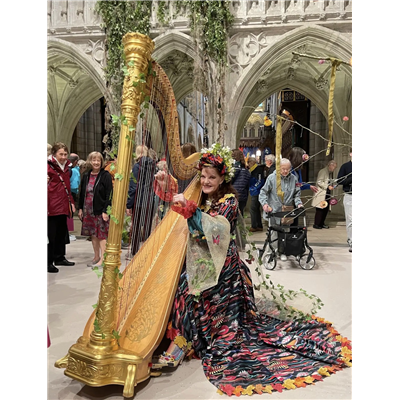
| 'LIFE ON A HARP STRING' – The History, Design and Music of this Unique Instrument |
| Margaret Watson |
 |
To book a seat click here AGM at 10.15 (coffee served from 9.45a.m.)
A jam-packed hour of information and entertainment. Take a trip with Margaret as she delves into the 5000-year history, development, design, music, and lore of this fascinating instrument. Boasting over 1400 working parts, you will learn how the complex pedal mechanism was introduced and perfected into the instrument played today, together with slides of the extraordinary designs as the instrument developed over the centuries. Indulge in the lavishly decorated Rococo harps made for Queen Marie -Antoinette, the fashion statement that became associated with the instrument - and listen as Margaret plays her harp for you on this unique musical journey.
Lecturer: Margaret Watson is an accomplished harpist, she studied harp under the late Sidonie Goossens OBE and Sussex harpist Helen Arnold. She holds a Diploma in Music Performance on the Harp and is also a Fellow of The Guild of Musicians and Singers. She has played in front of many royals, and given concerts at National Trust properties and many other venues. |
|